The landscape of higher education and professional training across the United Kingdom is undergoing a profound digital transformation. Within the healthcare sector, this evolution is driven by a critical discipline: nursing informatics. As the National Health Service (NHS) accelerates its Long Term Plan to deliver digitally enabled care, the integration of data science, information technology, and clinical practice has transitioned from an advanced elective to a core academic necessity. Modern nursing students are no longer just learning patient anatomy and bedside care; they are mastering electronic health records (EHRs), telehealth platforms, and predictive healthcare analytics.
This digital shift presents a dual challenge for the current generation of students entering UK universities. While technology streamlines patient care on the hospital ward, it significantly complicates the academic curriculum. Undergraduate and postgraduate nursing modules now demand high-level proficiency in data auditing, health metrics analysis, and digital governance. Balancing rigorous clinical placements with complex technical modules leaves many students struggling to maintain their academic standing.
When professional placement hours clash with rigid university deadlines, finding authentic academic balance becomes imperative. Many undergraduate students find that navigating these complex digital modules requires external guidance to successfully complete their technical modules; in such demanding scenarios, finding a reliable service to help do my coursework can provide vital support for those balancing clinical shifts with intense research requirements. This targeted academic support allows aspiring NHS professionals to master complex informatics theories without compromising their practical hands-on training.
The pressure is particularly acute given the rigorous standards upheld by regulatory bodies like the Nursing and Midwifery Council (NMC). As the NMC embeds digital literacy deep into its future nurse proficiency standards, academic workloads have increased in complexity. From understanding the ethical implications of artificial intelligence in diagnostics to managing cybersecurity protocols under UK GDPR, students face an steep learning curve. Consequently, accessing specialized healthcare assignment help has become a common strategy for individuals aiming to translate highly technical digital health concepts into top-tier academic essays and case studies.
Key Takeaways
- Informatics is Mandatory: Digital literacy and nursing informatics are now baseline requirements embedded within the UK’s NMC proficiency standards.
- Dual Workload Pressure: UK nursing students face a unique double burden: mastering complex digital data systems while completing demanding, unyielding clinical placements.
- NHS Alignment: Modern healthcare training programs are directly rewriting curricula to match the NHS’s digital-first operational frameworks.
- Academic Support Synergy: Strategic use of specialized academic resources helps bridge the gap between practical clinical competency and complex technical writing.
Defining Nursing Informatics in the UK Ecosystem
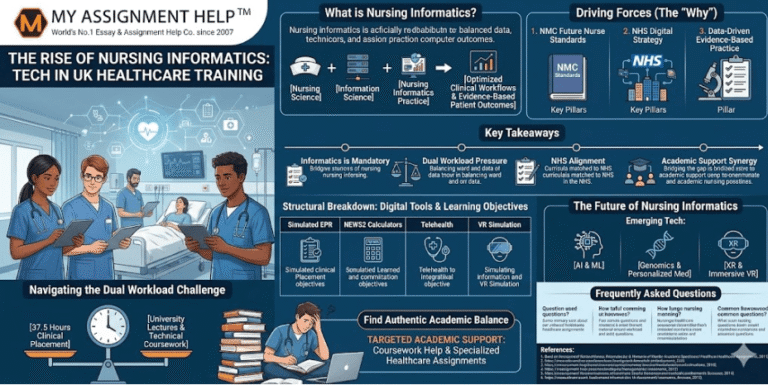
To understand the transformation of healthcare training, one must first define what nursing informatics means within the structural framework of UK healthcare. At its core, nursing informatics is the specialty that integrates nursing science with multiple information management and analytical sciences to identify, define, manage, and communicate data, information, knowledge, and wisdom in nursing practice.
[Nursing Science] + [Information Science] + [Computer Science]
│
▼
[Nursing Informatics Practice]
│
┌──────────────────┴──────────────────┐
▼ ▼
[Optimised Clinical Workflows] [Evidence-Based Patient Outcomes]
In the context of the UK, this is intrinsically tied to the digitalization of the NHS. The drive toward a “paperless NHS” has necessitated that every entering clinician is completely fluent in digital health systems. This includes:
- Electronic Patient Records (EPR): Navigating centralized databases such as Epic or Cerner, which are standardized across numerous NHS Trusts.
- Point-of-Care Technology: Utilizing mobile health applications, smart pumps, and wearable sensors that stream real-time patient vitals directly into medical charts.
- Clinical Decision Support Systems (CDSS): Interfacing with algorithmic tools that alert nurses to potential drug interactions or early signs of patient deterioration, such as rising National Early Warning Scores (NEWS2).
Driving Forces Behind the Digital Shift in Healthcare Training
The complete overhaul of UK nursing curricula is not arbitrary; it is a calculated response to macroeconomic factors, regulatory mandates, and lessons learned from global health challenges.
1. The NMC Future Nurse Standards
The Nursing and Midwifery Council (NMC) set out clear guidelines demanding that registered nurses must be able to deploy digital technologies effectively to support delivery of care. This mandate shifted informatics from an isolated computer-lab session to an omnipresent element woven through every single academic module.
2. The NHS Digital Strategy and Long Term Plan
With billions invested in upgrading the digital infrastructure of the NHS, there is a stark realization that cutting-edge software is useless without a workforce capable of operating it. Universities working in partnership with NHS Trusts have systematically aligned their learning outcomes to ensure graduates can step onto a ward on day one without requiring baseline digital remediation.
3. Data-Driven Evidence-Based Practice
Modern clinical governance relies heavily on big data. Nurses are increasingly required to participate in local and national clinical audits, extracting data from digital systems to identify patterns in patient care, infection rates, and readmission statistics. This requires a strong foundation in statistics and research methodologies.
Structural Breakdown of Digital Tool Adoption
To visualize how deeply technology has permeated current training pathways, consider the following structural breakdown of tools currently utilized across leading UK schools of nursing:
| Digital Tool Category | Specific Application in UK Training | Primary Learning Objective |
| Simulated EPR Systems | Mock electronic records tailored for classroom environments. | Accurate clinical documentation and compliance with UK GDPR. |
| NEWS2 Digital Calculators | Mobile and tablet-based early warning scoring systems. | Rapid identification of deteriorating patients and clinical triage. |
| Telehealth Platforms | Virtual consultation software and remote patient monitoring tools. | Managing community care and outpatient clinics remotely. |
| VR Clinical Simulations | Virtual Reality headsets simulating high-stress ward scenarios. | Developing critical thinking and crisis management without risk. |
The Academic Hurdle: Balancing Data and Diagnostics
While the long-term benefits of a digitally literate nursing workforce are undeniable, the immediate impact on students is a dramatic escalation in academic pressure. The traditional nursing student’s main worry used to be mastering anatomy, pharmacology, and hands-on patient care. Today, that same student must also act as a data analyst.
An average week for a modern nursing student in the UK involves a grueling balance:
[ 37.5 Hours Clinical Placement ] + [ University Lectures ] + [ Technical Informatics Coursework ]
When writing essays or completing portfolios, students cannot simply state that they administered care; they must critically evaluate the technological frameworks governing that care. They must write extensively on the ethical boundaries of automated triaging, data security breaches within medical networks, and the socio-economic disparities highlighted by digital health exclusion. This requires an exceptionally high standard of academic writing and synthesis—skills that take time to develop, a luxury that many exhausted placement students simply do not possess.
See also: How to Reduce Stress Hormones: Proven Strategies for a Calmer Mind and Body
The Future of Nursing Informatics: What Lies Ahead?
As we look toward the future of healthcare in the United Kingdom, the integration of technology will only accelerate. Several emerging fields are poised to become standard fixtures in undergraduate nursing education before the end of the decade:
Artificial Intelligence and Machine Learning
Predictive analytics tools are already being piloted to anticipate patient falls and sepsis onset hours before physical symptoms present. Future nurses will need to understand the underlying logic of these AI models to avoid automation bias—the tendency to trust an algorithmic output over human clinical judgment.
Genomics and Personalized Medicine
As genomic sequencing becomes accessible within the NHS, nursing informatics will play a vital role in managing the massive data sets required to tailor treatments to an individual’s genetic profile.
Immersive Extended Reality (XR)
The use of Virtual and Augmented Reality will expand from basic clinical simulations to complex multi-disciplinary crisis training, allowing nursing, medical, and pharmacy students to collaborate virtually within highly realistic, simulated emergency departments.
Conclusion
The rise of nursing informatics is fundamentally redefining what it means to be a healthcare professional in the United Kingdom. By bridging the gap between clinical excellence and digital proficiency, modern training programs are developing a resilient workforce capable of steering the NHS through the complexities of the 21st century. While the academic journey to mastering this dual discipline remains steep, the strategic implementation of innovative training methodologies, clear regulatory guidance, and focused academic support structures ensures that the future of UK nursing is exceptionally bright, highly secure, and undeniably digital.
Frequently Asked Questions (FAQs)
What exactly is nursing informatics, and why is it important in the UK?
Nursing informatics is the integration of nursing science, computer science, and data analytics to manage and communicate critical health information. In the UK, it is vital because it directly underpins the modernization of the NHS, ensuring patient data is used safely and efficiently to improve clinical outcomes.
How has the NMC integrated digital literacy into nursing training?
The Nursing and Midwifery Council (NMC) has embedded specific digital competencies within its standards of proficiency for registered nurses. This requires all nursing programs across the UK to formally assess a student’s ability to use digital health technologies, manage data ethically, and practice safely within digital environments.
Why do nursing students struggle with informatics modules compared to traditional care modules?
Informatics modules require a distinct shift in thinking from practical, empathetic bedside care to analytical, structured data management. Students must master complex concepts like health data governance, UK GDPR, and electronic system workflows while simultaneously completing full-time clinical placements, creating a significant logistically and intellectual challenge.
Can digital tools completely replace hands-on clinical simulations?
No. Virtual reality and digital simulations are designed to enhance and prepare students for physical care, not replace it. They provide a safe space to practice decision-making and critical thinking, but hands-on clinical placements remain an irreplaceable component of UK nursing education.
How does understanding NHS digital infrastructure benefit a newly qualified nurse?
A nurse who is already fluent in electronic patient records, digital alert systems, and clinical data auditing can transition seamlessly into a hospital ward on day one. This significantly reduces onboarding times, minimizes clinical documentation errors, and allows the nurse to focus more attention directly on patient care.
References and Strategic Sources
- Nursing and Midwifery Council (NMC). Standards of proficiency for registered nurses. London: NMC. Available at official regulatory access portals.
- NHS England. The NHS Long Term Plan and Digital Transformation Strategy. London: Department of Health and Social Care.
- Topol, E. The Topol Review: Preparing the healthcare workforce to deliver the digital future. NHS Health Education England.
- Royal College of Nursing (RCN). Digital Readiness and Nursing Informatics Guidance Series. London: RCN.
Author Profile
Eleanor Vance holds an MSc in Nursing Informatics and has over a decade of experience working alongside academic institutions across the UK to develop specialized digital health learning frameworks. As a senior content strategist and academic mentor for MyAssignmentHelp, Eleanor specializes in translating complex NHS data strategies and clinical governance protocols into accessible, high-scoring educational materials and support guides for the next generation of UK nurses.